Technical Analysis and Advantages of Branching from Thin-Walled L. Pipes
1. Introduction
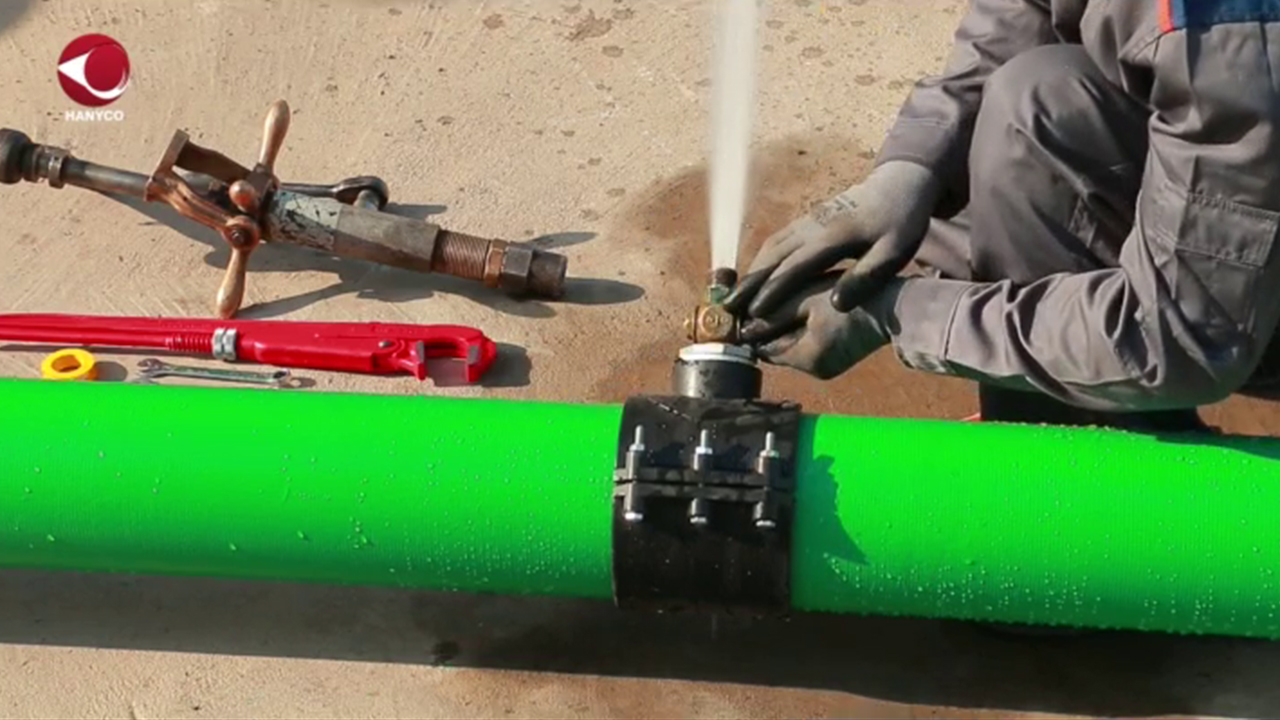
In water transmission and distribution networks, branching operations are one of the most important stages of the process. Considering the use of up-to-date world technology in the production of thin-walled pipes, “Hamoun Nayzeh” Company is proud to announce that tapping from these pipes is carried out without the need to shut off the flow and water pressure inside the pipe, and this initiative also prevents force concentration and unauthorized deformation in the pipes.
2. Technical and Economic Advantages of Tapping in Thin-Walled Pipes of Hamoun Nayzeh Company L.Pipes
A) Preserving Structural Integrity
Unlike common methods that generally lead to significant damage and weakening of the pipe cross-section at the connection point, the technologies used in products related to Hamoun Nayzeh prevent the “stress concentration” phenomenon by distributing stress around the tapping point. This feature ensures that, despite the low thickness of the pipe (thin wall), the pipe’s resistance to internal pressures and external loads (traffic or soil) is maintained.
B) Reduction of Operating Cost & Time
Tapping from thin-walled pipes, due to lower weight and greater flexibility at the connection point, greatly increases the speed of project execution. Reducing the need for light and heavy machinery for transportation and bedding at the tapping point also directly leads to a reduction in project costs (CAPEX). Also, the lack of need to shut off the flow during tapping increases execution speed and reduces tapping costs.
C) Flow Optimization
Tapping connection fittings (such as tees, tapping saddles, etc.) are designed in such a way that the “pressure drop” phenomenon at the connection point is minimized. In water transmission systems, this prevents flow turbulence and reduces the erosion caused by it in the long term.
D) Perfect Sealing and Long Lifespan
Tapping in Hamoun Nayzeh thin-walled pipes does not cause serious damage to the external coatings, and after the tapping operation, using external coating repair kits, it leads to stability and improvement in product performance and lifespan. Also, tapping in these pipes provides the possibility of complete sealing (if tapping requirements are fully observed, the internal coating of the pipe does not need repair), and by creating a protective layer at the connection point, the risk of galvanic or chemical corrosion at the tapping point is minimized.
3. Summary of Technical–Engineering Points
- Reduction of force and stress concentration: uniform load distribution at the tapping point.
- Economic efficiency: reduction in excavation, as well as human resource costs, and no need to shut off water flow and pressure during tapping.
- Hydraulic performance: improved flow pattern and reduced local pressure drop.
- Stability: full compatibility of the connection in tapping fittings with the structure of Hamoun Nayzeh Company’s thin-walled pipes.
Suggested References for Inclusion in the Report
- Instructions and technical catalog of Hamoun Nayzeh Company’s products and connections.
- Iran National Standards INSO 21376 and BS-EN-12842.
- Publication 128-3 (Executive Guideline for Laying Water Transmission Lines).