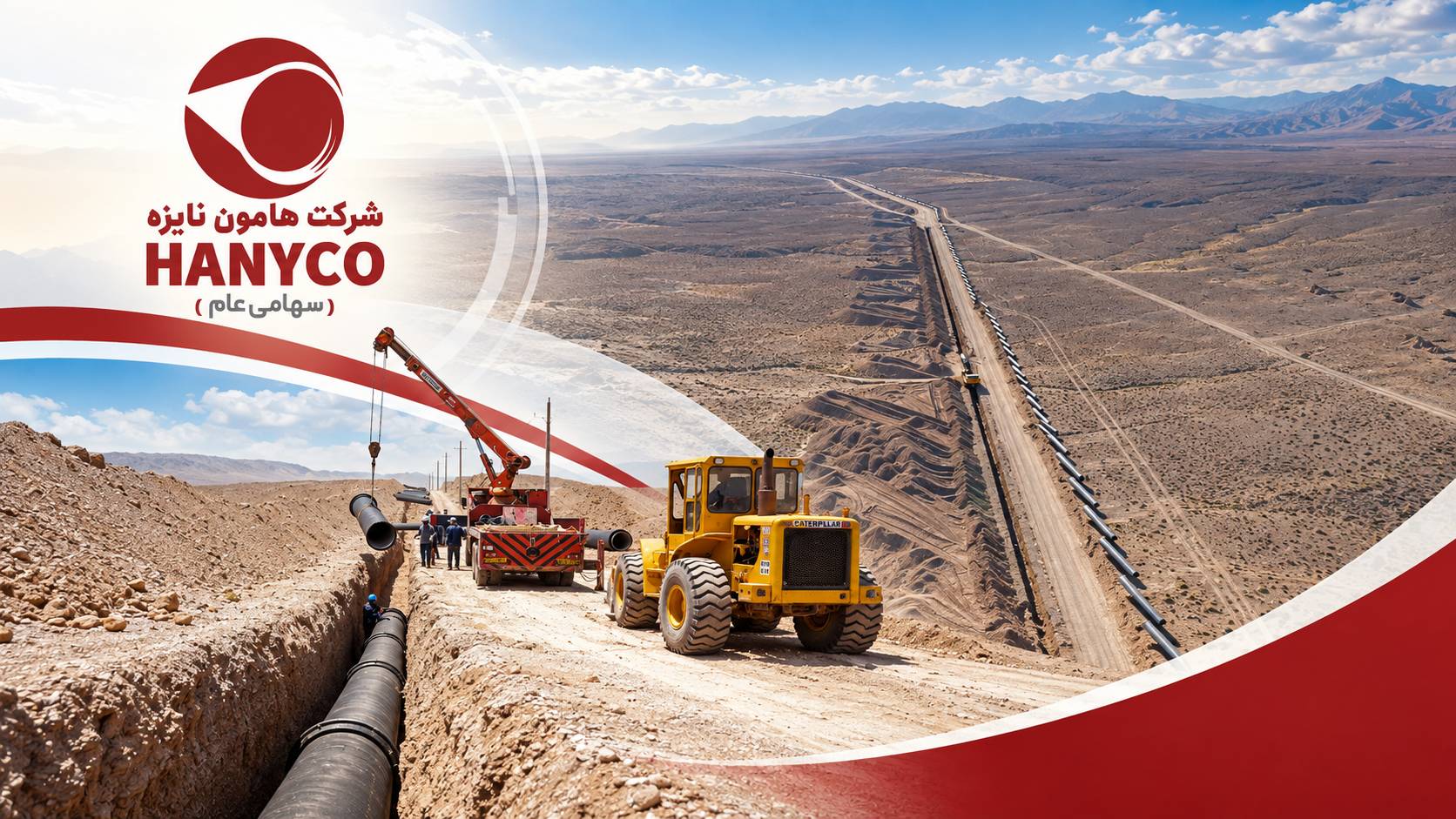
This report documents the successful experience of a strategic change in pipelaying technology for the water and effluent transmission lines of the Sangan Steel Complex. In the first project, an effluent transmission line with a length of 38 km was implemented using DN800 ductile iron pipes with Tyton and seismic-resistant joints (Restrained Joint – RJ), manufactured by Hamoun Nayzeh. In the second project, a 28-km transmission line was selected with DN700 ductile iron pipes.
The project routes are located in the eastern belt of Iran, adjacent to Afghanistan; an area where, due to strong and continuous winds, the execution of welding steel pipes — which had been envisaged in the initial design — faced serious challenges. The decision of the employer and consultant to change the technology to seismic- resistant ductile iron, while fully resolving the implementation problem, brought significant economic benefits, including the elimination of cathodic protection and the elimination of concrete blocks. Repeating this choice in the second project is the best evidence of the technical and economic validity of this solution.
This report has been compiled based on field information provided by the employer and the project executor. The main specifications of the two Sangan Steel water transmission line projects are as follows:
| Characteristic | First Project | Second Project |
|---|---|---|
| Transmission line length | 38 km | 28 km |
| Pipe size | DN800 | DN700 |
| Material and joint type | Ductile iron | Ductile iron |
| Application | Water supply for Sangan Steel Complex | Water supply for Sangan Steel Complex |
| Geographical location | Eastern belt of Iran (border with Afghanistan) | Eastern belt of Iran (border with Afghanistan) |
The initial design of both projects was based on steel pipes; however, the implementation experience of the first project paved the way for the definitive selection of ductile iron pipe in the second project. The strategic importance of these lines lies in the fact that the water consumed by steelmaking is a vital production requirement, and any interruption of the line causes heavy industrial losses.
In the initial design of the project, the use of steel pipes had been envisaged. With the start of execution operations in the windy region of the country’s eastern border, the technical team faced challenges that made continuing the steel method practically uneconomical and risky:
· Impossibility of creating a stable welding environment: Strong and continuous winds eliminated the possibility of creating a standard welding bay and a safe environment, even with the installation of protective tents at the assembly site.
· Risk of weld quality loss: Pipeline welding is sensitive to environmental stability; air turbulence causes porosity in the root and fill passes, reduces the quality of joints, and lowers the useful life of the line; an issue that is considered a critical weakness for an industrial water transmission line.
· Slow physical progress: Repeated unsuccessful welding attempts led to frequent stoppages and waste of welding and inspection resources, and endangered the project schedule.
This field experience showed that the choice of pipe technology must be reviewed in accordance with the climate of the execution site, not merely based on conventional design practices.
To overcome the implementation deadlock, the employer and project consultant changed the pipe type to Tyton and seismic-resistant (RJ) ductile iron manufactured by Hamoun Nayzeh. This decision brought the following technical advantages:
RJ joints are installed mechanically and in a locking manner; therefore, project progress has no dependence on weather conditions, and installation speed does not change under different weather conditions such as wind, storm, or heat. Elimination of welding and related non-destructive inspections (RT/UT) removed the longest part of the project from the schedule, and human error in joints was replaced by mechanical locking.
Unlike steel pipes, which unavoidably require a cathodic protection system and its continuous maintenance, ductile iron pipes do not need cathodic protection due to their metallurgical nature and resistant internal and external coatings. The result is reduced operating costs (OPEX) and elimination of depreciation and monitoring of the cathodic system over the 50-year life of the line.
The RJ joint, due to its locking mechanism and inherent flexibility in the joint, tolerates tensile and compressive stresses caused by earthquakes and asymmetric soil settlements without rupture and allows limited angular deflection at each joint; the use of this type of restrained joint creates integrity of the pipelines and distributes the resulting stresses and strains among different parts of the pipeline. Among the main properties of this type of joint are no need for bolts and nuts and ease and speed in the assembly and disassembly process.
The use of RJ joints in ductile iron piping systems can, subject to performing restraint calculations and providing the required restrained length, make it possible to eliminate the need for concrete thrust blocks at changes of direction and branches, including elbows and tees.
This creates significant savings in the volume of concreting operations and execution time. Also, the low internal friction coefficient of ductile pipe reduces head loss and improves pumping efficiency in the 40-km line of the first project and the 37-km line of the second project.
The RJ Pipe joint is an advanced design of a Push-in Flexible Restrained Joint, whose locking system prevents the pipe from separating during thrust or ground settlement. Assembly of R.J Pipe pipes, similar to Tyton pipes, is of the push-in type, which is done easily and quickly. The sealing process begins after the specially designed gasket is placed inside the socket, and then, with the spigot of the adjacent pipe placed inside the socket, and finally by turning the gland to the proper position, placing the locking segment, and installing the split spring pin, the assembly process is completed.
The selection of Tyton and seismic-resistant pipes, size 800 mm, made of ductile iron, manufactured by Hamoun Nayzeh, in the first effluent transmission project for Sangan Steel Company with a length of 38 km, showed that this technology in the windy climate of the country’s east meets the challenges that had stopped the execution of steel pipe; such that the execution of the ductile iron pipeline was evaluated as suitable and successful by the employer and project executor.
Therefore, in the second project (28 km, DN700), the same pipe with the Hamoun Nayzeh brand became the first and definitive choice of the employer and consultant.
This repetition of the decision is the most reliable proof of the technical and economic superiority of ductile pipe: elimination of welding in a difficult climate, elimination of cathodic protection and its maintenance costs, high speed of mechanical installation, and long-term stability of the line against ground movements. It is recommended that this successful model be used as the basis for selection in other water transmission projects in windy and seismic regions of the country.
1. Field data and description of implementation experience, provided by the employer and project executor of the Sangan Steel water transmission line projects.
2. Publication 128 (Guideline for Design and Execution of Pipelaying), Plan and Budget Organization of Iran.